
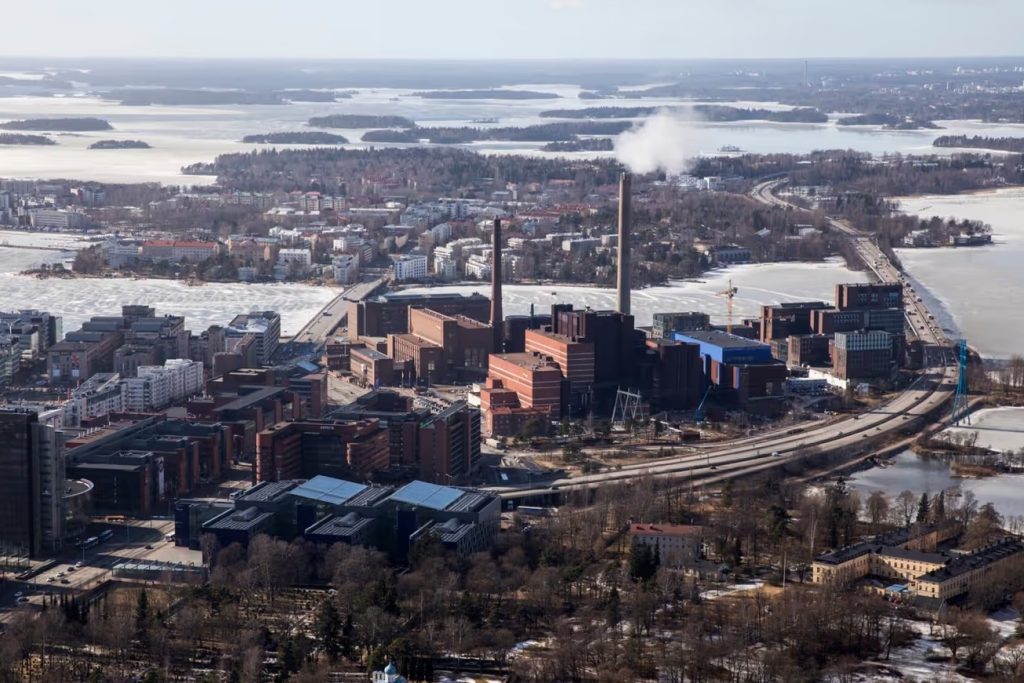
On 15 September 2026, the European Investment Bank (EIB) committed up to 40 million euros to Steady Energy, a Finnish start-up developing a small nuclear reactor that produces heat only, for district heating networks. The financing takes the form of a senior unsecured convertible loan, which gives the bank the option of converting it into listed shares, and is the EIB’s first investment in small modular reactor technology. It will fund research, testing and licensing activities in Finland between 2026 and 2028. It is one data point in a broader movement: after decades of ever-larger power plants, the nuclear industry is developing much smaller reactors, and a share of them are aimed at heat as well as electricity.
Smaller reactors built in factory modules
Small modular reactors (SMRs) and advanced modular reactors (AMRs) are low-power designs. France’s energy regulator, the CRE, uses the International Atomic Energy Agency benchmark of less than 300 megawatts electric, a third or less of the output of a large reactor, with most designs between a few tens and 300 megawatts. SMRs are water-cooled, while AMRs use other coolants such as molten salt, sodium, lead or gas. The idea is factory production of standardised modules rather than one-off construction on site.
Compact reactors are not new in France. TechnicAtome, which has worked with Naval Group for more than fifty years, designed the reactors of the French nuclear attack and ballistic-missile submarines and of the aircraft carrier Charles de Gaulle; 21 reactors have been built since the first land-based prototype in 1964.
The regulator points to financing as the missing step
A report published by the CRE on 9 September 2025 states that, although China, Russia and the United States have taken the lead, none has yet reached series production, mainly for lack of funding. It puts the prototype phase at around one billion euros per project and calls for significant financing, organised by each country or, better, at European level, concentrated on the most promising SMRs. The working group behind the report was co-chaired by Anne-Marie Choho, managing director of the engineering group Setec, and François Lévêque, professor of economics at Mines Paris-PSL. It sets SMR commercialisation in the 2030s and, for the AMRs best placed to supply high-temperature industrial heat, a contribution around 2040-2050.
An American example of that financing risk: the Carbon Free Power Project, meant to install six 77-megawatt NuScale modules (462 megawatts) for a group of Utah municipal utilities, was terminated by mutual agreement on 8 November 2023 because it appeared unlikely to attract enough subscriptions.
Where funding has gone since
Elsewhere, financing has kept moving. In France, Calogena, a subsidiary of Groupe Gorgé developing a low-power nuclear boiler for heating networks, reached close to 100 million euros of financing, combining 48 million euros of France 2030 aid announced at the Nuclear Energy Summit on 10 March 2026 with a capital increase that brought in the engineering group Snef, Banque des Territoires and the Deep Tech 2030 fund managed by Bpifrance; it targets deployment from 2030. In the United States, Amazon anchored a Series C-1 round of about 500 million dollars for X-energy in October 2024, with a target of more than 5 gigawatts of new projects by 2039 and an initial four-unit, 320-megawatt project with the utility Energy Northwest. In March 2026 the US Nuclear Regulatory Commission approved the construction permit for the Natrium plant of TerraPower, in Kemmerer, Wyoming: the first construction permit the NRC has ever issued for a commercial non-light-water power reactor.
District heating as a second use case
Steady Energy’s project in Helsinki points to a use case beyond the data-centre demand behind most American deals: district heating. The company is building a non-nuclear pilot in the turbine hall of Salmisaari B, a former coal-fired plant owned by the utility Helen; first concrete was poured on 12 February 2026, the pilot uses electric resistance elements in place of a reactor core, and operations are scheduled to begin in spring 2027, with the heat fed into Helen’s network. Steady Energy says its goal is to be ready to begin building its first plant within three years, according to its chief technology officer, Hannes Haapalahti (June 2026). Calogena and Steady Energy also lead CityHeat, a project selected in October 2024 by the European Industrial Alliance on SMRs.
Between a terminated American project and a Finnish pilot backed by EU public money, the sector’s near-term test is the one the CRE report describes: whether public and private financing can be concentrated on enough projects to reach series production, which, according to the CRE’s report of September 2025, no country had yet achieved.
Photo: Steady Energy. Aerial view of the Salmisaari area, Helsinki, site of the company’s pilot plant.